Sunday, 18 July 2010

From Poverty to Africa: Retrospection Part 2 - Characters

Thomas Dubois, played by Matthew Tisot
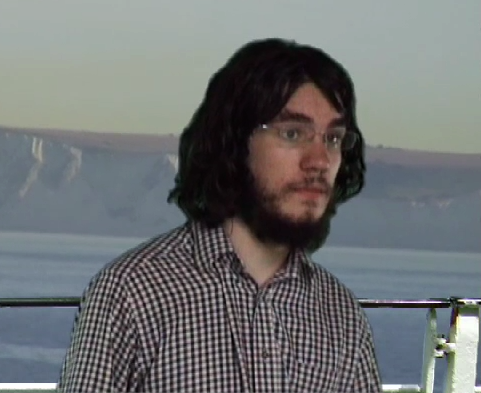

Thomas is quite clearly supposed to be the main character: it is his poverty that the title references, and he is the one who starts the story for the first time at the beginning of the film. Yet Thomas is consistently overshadowed by the other characters, including Questa, who almost certainly has more lines than him. This is partly because the other characters are just generally more comic, but also because of inconsistency in his character. He is supposed to have grown up in the inner-city slums, to have had numerous addictions and to have been involved in petty crime, yet if it weren't for the fact that this was specifically revealed to us at the start, we probably wouldn't notice. Though specific mention is made of his lack of formal education, he speaks very eloquently and comes up with very logical and intelligent arguments. All of this is ostensibly due to the civilising effect of Questa and her elocution lessons, but this certainly sounds like a contrivance. In the hotel room, Thomas talks about a few of the events from his past; after that, he essentially becomes furniture until the very end, making only a brief come-back to fend off an inflatable crocodile.

The inconsistent character is not helped by Matthew's inconsistent acting. While some of it is good, other bits are dull. Sometimes he displays genuine character, such as when he relates the tale of the chicken in the fast food shop, yet he never acts like this at any other point in the film and loses this character immediately afterwards when talking about his pancreas transplant. Compare also his delivery of "That's the second time this week - unbelievable!" at the start with the line immediately afterwards, "So, anyway, why don't you tell Señora Gaitán our story?" It seems as though we just didn't know what Thomas is supposed to be like. Another part of the problem, of course, is that he doesn't have much of interest to say; Questa and Jeanne steal all of the interesting lines, especially towards the end, where Thomas' only purpose is to be confused and ask the right question so that the exposition can move forward. Matthew spent a long time trying to get the "Wow, and speaking of the world..." line right, and the result is generally quite good, if a little slowly delivered (while he tries to remember how the next bit goes).

Memorable line: "The extent of your manipulations is unbelievable!"
Worst line: "Anyway, back to the piece of paper."

Questa Dubois, played by Charlotte Kay


Two somewhat contradictory questions about Questa come to mind: firstly, is she perfect? Secondly, is she stupid? She understands Thomas' problems, and accepts him as a person despite his criminal past; she puts a firm stop to his addictions and stops him from taking up drinking. She is absolved of any blame for Jeanne's situation and suggests that she would have helped her if she could have. Partly for these reasons, Questa seems to have no character flaws, although she does display some impatience, such as on the London Underground. At the same time, she fails to fight back against her mother's tyranny, just accepting whatever she says almost unquestioningly. She may be afraid of her mother, but she doesn't even seem to show any sign of resentment, or even unhappiness. She just seems to want to make the best of the situation. We may suspect Questa of being an idiot for a number of reasons: she fails to recognise her cousin Jeanne; she wonders why the English people all look "strangely similar" without considering that they might be the same person; she stupidly remarks to her mother on the phone, "I can't tell you if she's here or not; she's told me not to say anything", despite having a gun in her face; and, of course, she married Thomas. There were further examples of Questa saying stupid things which were cut in the final version. Despite all this, Questa shows signs of being intelligent: she has an impeccable grasp of French military history; she isn't satisfied with Thomas' shrugging-off of the camel's glowing; she was supposed to have taught Thomas what he knows; and she makes generally very cogent and analytical remarks about most things, particularly in her voice-overs.

Questa's character is more consistent than Thomas', but still seems to be lacking something. This was going to be addressed further in the new scenes that we had planned: Questa was afraid of being disinherited, for example, which was going to explain why she didn't dare anger her mother too much. As it is, we have to be thankful for Charlotte's acting, which consistently made the best of the inconsistency. She injected emotion precisely where needed, and, unlike Matthew, she continued to act even when she didn't have any lines, which certainly saved the wedding reception scene from being even duller than it already was.

Memorable line: "Everyone's life is important!"
Worst line: "In fact you could say that this is the story of their products."


Jeanne Lefèvre, played by Amber Prosser


From her first major appearance on the train, Jeanne/Amber immediately provides the film with some much-needed colour. In fact, Jeanne's success in the train scene is entirely down to Amber, whose impromptu newspaper-peering antics were not detailed in the script, yet were perfectly consistent with the deranged but nefariously cunning antagonist that she plays. Her acting was, however, somewhat variable - her performance in scenes 15 (on the cliffs), 18 (in the tent) and 39 (in the inn) being somewhat flatter than her outlandish enthusiasm in scenes 40 (outside the inn), 20 (at the shop in 'London') and 47 and 49 (on the common). Generally, the scenes that were filmed later are better, presumably because she had had more time to grow into the role and to learn the fiendishly difficult lines. Given the tight schedule and the sheer length of her lines, Amber's patience and overall performance is laudable.

Jeanne is one of the better-developed characters in the story and it is perhaps a shame that we don't really get too close to her; she is, for the most part, presented as the 'other' - the mysterious stalker, the shady villain, the one who's silently pulling all the strings, right up until her plan backfires, the aliens dispose of her and she's never heard of again. Jeanne is hence not the overarching antagonist, since it quickly becomes clear that the threat posed by the aliens is orders of magnitude more serious than any damage Jeanne could have done with her hypermarket. It would not be at all controversial to say that the villains and the interactions between them are far more interesting than the protagonists. Betrayal and back-stabbing are the order of the day: Jeanne gets the ninjas to betray Claire by setting the Ultimate Gaullist Weapon on her; Jeanne then disposes of the ninjas when they refuse to join her; Claire almost looks as though she has a strange-hold over Jeanne, before Jeanne asserts her cunning once again; and finally the aliens betray her.

Memorable line: Too many to choose from! How about, "Don't come any closer! I like my personal space."
Worst line: "Brilliant, brilliant, but I mean, as I say..."


Claire Montpellier-dit-Michel, played by Rosemary Reeves


When I first read the original version of the script, I found scene 9 (the wedding reception scene) extremely funny and also somewhat innovative for being a stereotypical 'villain's exposition' that actually appears at the start of the film instead of the end. Unfortunately, this scene turned out to be rather dull, which was at least partly because Rosemary had not been able to learn her lines (and was consequently reading from a script for the whole scene! Bet you didn't notice!) and because she delivered them very slowly. In other places, her acting was memorably good - "Silence! Or I'll kill you!" - and her non-verbal acting was usually appropriate for the unhinged, power-hungry, wicked interfering mother-in-law that she was playing.

Claire is a reasonably interesting and entertaining character overall. Unlike in early versions of the script, she re-appears near the end of the film, which helps for the cohesion of the film in general but does drag out the already over-long scene 52 (the long exposition on the common). Claire's final fate isn't mentioned - she fizzles out along with Questa's mobile phone battery - and this could leave the hypothetical audience wondering how Thomas and Questa managed to escape her grasp and do what they wanted, i.e. remain married and set up their project in the Congo. The scrapped new scenes would have explained that Claire died of a haemorrhage after getting into a fight with a union woman who was trying to get better working conditions at the Montpellier-dit-Michel lumber mills; Questa then inherited the fortune and used it to finance the eco-village in the Congo.

Memorable line: "Tell me now or I'll rip off both your arms and beat you... with their soggy ends."
Worst line: "What's this? It says it's a family tree..."


Claudia García Gaitán, played by Maddy Lawrence-Jones


Most of the film is a story that Thomas and Questa are recounting to Gaitán, and this would suggest that Gaitán is a significant character. However, her role is solely to listen: we needed to introduce the idea of the story being narrated (for reasons I mentioned in part one), and that means we needed someone to be narrated to. Gaitán is from some "organisation in Venezuela" whose purpose is never explained. Her appearance is official and perhaps even intimidating, but she appears to have a sense of fun and isn't afraid to fall fast asleep when the story gets boring. We recorded a number of shots of Gaitán in various stages of boredom and sleep, and Maddy's non-verbal acting here was quite superb. The idea of inserting these clips, however, is of somewhat questionable purpose; we were effectively saying, "Yes, we know this bit is boring". According to Gaitán, the story is "very... detailed", which is, of course, a polite way of saying that it's exceptionally dull. After all, there is no reason why Thomas and Questa would have to go into the excruciating detail that they did, and I also see no reason why Gaitán felt it necessary to put up with it. The overall impression I get from this is that Thomas and Questa are just exceedingly sad people.

Some people have said that Gaitán was hard to understand, which I imagine is more because of the Spanish accent than the volume. Those familiar with Spanish will find it quite authentic.

The scrapped new scenes were going to develop Gaitán into a major character. She was to be a reformed drug dealer who was responsible for the death of the fiancée of the scrapped character Darryl Dycho.

Memorable line: "Have you heard this estory of theirs? It's very... detailed..."
Worst line: "You are the product of the couple in Cévennes National Park."


Monique, played by Milly Paine


Monique is perhaps the most colourful character in the film: an ex-security guard who is now completely obsessed with yams and only speaks in rhyme. Who could fail to be enchanted by such a ridiculous personality? In fact, I would almost be tempted to say that there is more character and interest packed into Monique's relatively brief role than there is in Thomas and Questa put together. In this way, I think Monique is one of the film's great assets. Her history as a security guard neatly allowed us to remind the hypothetical audience of Thomas' past, and if there were more time, it would have been an interesting relationship to explore.

Milly plays the character very well, though I would suggest that she delivers the rhymes a little too quickly. This was probably due to the fact that she and Maddy were practically incapable of keeping a straight face and so she needed to get through the lines as quickly as possible before she burst out laughing.

Memorable line: "Wham! Have another yam!"
Worst line: "Thank you for your introduction Thomas; unfortunately I have some very serious news to offer" (not a bad line, really).


The Ninjas, played by James Strachan and Luke Warner


Is it justifiable for me to treat the ninjas as though they are one character? Well, I don't care. They don't even have individual names (though the scrapped new scenes were going to christen them Vivantpierre and Battantpierre). The ninjas, like Monique, add some much-needed originality and spice to the film. As soon as the camera pans down on them in scene 26, we can tell that this is going to be good. Incompetent, gluttonous, Gaullist ninjas. Have you ever heard such a ridiculous concept? James and Luke's acting (and particularly James') add barrels of extra pizzaz - although the 'raised finger' gesture was originally meant to be much more prominent. One unfortunate problem with the ninjas is that their masks make their voice quality worse. Luke's acting was quite flat and hesitant in places.

Memorable line: "In the name of de Gaulle!"
Worst line: "Ninja huddle!"


Emma Scott, played by Starbuck Friend


Emma is the Scottish woman who talks to T&Q on Loch Ness. Her lines are amusing, but unfortunately spoilt by the traffic noise. It would have helped if the microphone were closer to her. This was the real reason why I added subtitles in the final cut, but the fact that her lines are in Scots provides a convenient excuse for making them obligatory. Emma's only purpose from the plot's point of view is to distract T&Q while Jeanne steals the camel. Starbuck's acting was very good, including vibrant gesticulations.

Memorable line: "Tay bad it ate him next."
Worst line: ?


The Ventriloquist, played by John Tisot


Now, a bit of background (which I explained in part one). You know that tripod that's standing behind Charlotte on the cliffs in scene 15? It wasn't meant to be there. I'm not sure why they didn't notice, but they didn't, and there's nothing you can do about it short of re-filming the scene, which was not really practical or desirable. So naturally we decided to make tripods (or rather, tripodula!) a major element of the plot. As such, Matthew introduced the ventriloquist scene in order to prepare the hypothetical audience for the fact that a tripod will shortly be on the shot. This scene is funny, in my opinion, and Mr. Tisot (Matthew's father) delivered the lines very well.


The Alien, played by Justin Morgan


The alien's lines in the stop motion sequences are not, in my opinion, particularly funny, nor are they particularly understandable (though that wasn't the point). They serve their purpose, though. The processing that I applied to my voice is quite effective, I think: I didn't want it to be too extreme in case it made it inaudible, but I did make it go deeper or weirder at appropriate points (e.g. "the time for killing is upon us"). My voice acting is generally OK.

Memorable line: "You humans go on about such drivel" (another self-referential dig at how boring the script is)
Worst line: "People start acting like headless llamas"


The Panicked Passengers, played by Ben Pennington and Starbuck Friend


Classic. That is all.


The Parents, played by James Sidwell, Sarah Kilmister, Dan Omnes and Aphra Hurford


These don't have any lines - they appear at the beginning of the film as flashbacks of Thomas' and Questa's parents. I can't really think of any criticisms. James' acting was extremely good; Sarah's was also fantastic; excellent non-verbal communication in both cases. Dan and Aphra didn't have to do much, but they did it well enough.

James and Sarah also provided the voice-overs for the comedy on the television:
"I AM your father! And thanks to gender re-assignment surgery... etc."
Great stuff.

Speaking of gender, consider the proposition that From Poverty to Africa is a feminist film. Consider - it is Mrs. Dubois, not Mr. Dubois, who is wheeling the wheelbarrow and doing the heavy work; similarly, the young Claire is the one who wields the axe; the major antagonists, Claire and Jeanne, are strong, cunning and ruthless women; Gaitán is a senior official in her organisation; Monique is a former security guard; Questa exerts a good deal of authority over her husband and teaches him elocution and logic; and the male ninjas are highly incompetent. Now, we must certainly not fall into the trap of calling a film 'feminist' just because it happens to portray a lot of powerful women and stupid men; and indeed, there was no conscious intention behind these facts. The roles of Gaitán and Monique were specifically written as 'unisex' roles and Matthew just accepted whoever said yes first, regardless of gender. Though Thomas is still supposedly the main character, his fairly uninteresting role allows the large number of female characters to come to the fore and take over the helm - witness, for example, the back-seat that Thomas takes in scene 40, outside the inn, where Questa and Jeanne argue about the military history of the UK and France. But this, in my opinion, is not really noticeable unless someone points it out, and that's probably because it was unconscious. There is no feminist statement to be found here, and so the phenomenon is of no consequence, and certainly not a problematic one.

Advice


Character-related advice for other amateur film-makers:
  • Allow your actors a certain leeway in adapting the lines to suit their style: forcing them to stick rigidly to the script is likely to make it unnatural for them.
  • Similarly, provide scope for the actors to bring in their own particular flair, mannerisms or ideas - chances are, it'll turn out better than you imagined it.
  • NEVER compromise on line-learning. The advice above notwithstanding, if the actors struggle to do the scene without referring to a script, then they're not ready.
  • Accordingly, don't try to get filming done in an ambitiously short period of time. Give the actors plenty of time to learn the script and understand their role, and help them with this process as necessary.
  • Actors need to continue acting even when they don't have any lines.
  • If your actors aren't roughly as enthusiastic about each scene as you are, chances are you've got a boring script.
  • Always have a clear idea of what your characters' purpose, goals, opinions, history and general personality traits are while writing the script.
  • Think about how your characters are changed by their experiences throughout the film.
Next, we'll look at visual elements.

From Poverty to Africa: Retrospection Part 3 - Visuals

This post will deal with the technical and creative sides of the visual elements of the film; the next post will deal with audio elements.

Each scene in From Poverty to Africa was filmed with no more than three consumer-level miniDV camcorders. In the vast majority of scenes, these were mounted on stationary tripods, and each camera was given a different perspective (generally a wide shot and two close-ups). This allowed us to simply roll the cameras and do the scene and then worry about which shots to use in the post-production stage. Had we only used one camera, we would either have had to re-film the entire scene every time something went wrong, or we'd have needed to figure out in advance what shots we wanted and move the camera accordingly. This latter option could threaten the cohesion and flow of the scene, however, since the actors would have to wait for the camera to be moved every time a new shot was required, and any slight movements they made in the meantime would be more noticeable. This technique was employed in scene 15 (on the cliffs), however, and didn't impact it too greatly.

Using three cameras clearly allows the greatest flexibility, but it does use up three times the tape. Furthermore, you should ask yourself: is it better to get three cheap cameras, or one or two good quality ones? Based on our experiences, I would now be inclined to recommend going for two good quality HDV camcorders instead of three old-hat cheapy SD ones. The newer hard-disk-based cameras are also worth considering so that you don't have to worry about tapes. You'll have to have more hard disk space available on your computer for HD video, but that's actually extremely cheap nowadays.

A further issue we had is that we generally only ever had one camera operator available for each scene. One camera operator for three cameras. Great. That means every time the actors take their positions, someone needs to go around each camera checking that it's OK, and if one of the actors goes off shot in one of the cameras that you're not supervising - well, you can't tell. Somehow this was less of a problem than you might think, probably because most of the scenes are so sluggish that the actors stay in one position all the time.

As for the shots themselves, they were strikingly uninteresting and unimaginative. Wide shot, close-up, close-up. Totally static. Very little use of panning and zooming was made. One exception is the long zooming-in to Thomas on the streets of Marseille, which was quite effective. For most scenes, very little thought went into the creative impact of each shot. Most of the time we worked out which shots to have on the day of the shoot, and most of the time it was based on pragmatic rather than creative concerns.

Is Your Action Safe?


A slightly more arcane problem goes as follows. When you record video in a broadcast format (PAL or NTSC), a certain amount of it is cut off when the video is viewed on a television. The amount that's cut off varies somewhat by television. There is a region called the 'action safe' region, within which all action will definitely be visible on all televisions. There are two problems. Firstly, our consumer camcorders do not show the region outside of the action safe region on their LCD displays. Secondly, when you watch such a video on a computer, all of it is visible. Concretely speaking, that means that if the leg of a tripod is on the shot, but is outside of the action safe region, then a bit of it will be visible on some televisions and on any version of the video that is viewed on a computer. Take a look at the right-hand side of the wide shots in scene 40 (outside the George Inn in Frocester, pictured here) and you'll see a tripod leg. This wasn't visible in the camera's LCD display, which is why I didn't flag it up as an issue at the time of shooting. This issue becomes a MAJOR headache when it comes to the green screen shoots, but I'm dedicating a whole post to green screen issues!

There are three ways you can combat this problem (although it's too late for us of course). The best thing is to get a good quality camera that lets you see the entirety of the image being recorded. The second best thing is simply to take account of this phenomenon when shooting. The third idea is to crop out the 'invisible' region when exporting for web.

Lighting


Lighting was not an issue for us because we just ignored it. This didn't really impact on the final product that much, except when it comes to the green screen scenes, which I'll deal with separately. The worst scene for lighting was scene 18, however - the one in the 'Tent Modern'. This scene was filmed in a tent inside a village hall, and the tent itself was not lit. The scene ended up very dark, and I needed to adjust the gamma and apply colour correction to get it looking reasonably decent.

It may come as no surprise that a lot of the scenes in the film were filmed in the daylight but then post-processed to look as though they took place at night. The 'Day for Night' plug-in for Final Cut Pro was invaluable for this effect, although a very similar effect can be achieved by adding a dark blue tint and desaturating the image. The parameters of the Day for Night filter cannot easily be animated, however - i.e. you can't easily make it turn gradually from day to night or vice versa - but I achieved this effect nonetheless at the end of scene 39 (after the restaurant scene) by simply duplicating the clip, adding the filter to the upper clip and animating its opacity (and also decreasing the brightness). You didn't think we left the camera there overnight, did you? No, Matthew left it there for half an hour, and I sped it up to 15000% and added this effect.

It also gets dark at the end of the 'Race to the Finish' sequence. This was easier to do because the shot changes several times, so I simply used different parameters in each shot and didn't need to add keyframes.

At the beginning of scene 52 ('Betrayal and Showdown'), Thomas and Questa are sat in the car at Rodborough Common. In reality, daylight was streaming through the windows, so much so, in fact, that the windscreen was practically white. I removed the white with a luma key, stuck a picture of Rodborough Common on the video layer underneath and added the night-time filters to both layers. The effect is not perfect, but with more tweaking I could probably have improved it.

Cohesion


Scene 7, internally called "Love", is only 20 seconds long, yet, along with the "Kiss Conquers Camel" sequence at the end, it demonstrates an especially tight integration between visuals and music, as well as carefully-considered special effects and narrative techniques. It is worth examining these two scenes in more detail.

In scene 7, Thomas and Questa see each other for the first time in the woods and they fall in love instantly. Thomas drops his axe. Questa drops her logs. They run towards each other and embrace. The scene begins in black and white. All of the flashback scenes up until this point have also been in black and white, intended to symbolise not just the anteriority of the events but also the bleakness of Thomas' situation prior to his meeting Questa. As such, when he sees Questa for the first time in the woods, she alone is in colour, and the woods behind her are in black and white. As she runs towards him, the colour spreads out from her to fill the screen, and from thence on, the film is in colour. In this way, the special effects are clearly exploited to convey the idea of just how much Questa enriched Thomas' life. This scene, incidentally - exactly as I've described it - was part of the very first draft of the film that Matthew wrote, and, despite how clichéd and tacky the idea is, it is a masterful concept.

Remember, you cannot separate the foreground of a video from the background unless you film the foreground subjects on a plain colour background, i.e. a green or blue screen. This scene was not filmed using the green screen, yet I still managed to achieve the effect of isolating Charlotte in colour and putting the background around her in black and white. This was because most of the background consisted of leaves, which are, surprisingly enough, green. So I used the chroma key filter to key out the leaves. I then duplicated the clip and desaturated it (i.e. put it in black and white) beneath the foreground layer, which I cropped so that it framed Charlotte. I increased the edge thinning of the chroma keyer quite liberally, softened the edges, then applied a blur effect to the background to make her stand out even more. An interesting consequence of doing things this way was that when she drops the logs, they turn black and white (you'd have to watch it frame by frame to notice this really, though), which would convey the impression that Questa no longer cares about the logs. This would not have happened if we'd used a green screen (though you could still create the effect if you wanted to).

To make the colour spread out from around her, I duplicated the clip again with no keying or desaturation and placed it between the background desaturated layer and the foreground keyed layer. I applied an oval-shaped matte to this layer and simply animated its size. Similarly, when the shot switched to Thomas, I made the colour spread out towards him from Questa's direction.

I was able to compose music to fit this scene quite precisely. I used a 'call-and-response' structure, so that the piano represents Thomas and the flute that responds to it represents Questa. As the besotted pair get closer to each other, the piece gets faster and the piano and flute start to play together. The instruction at the top of the sheet music was "Allegro e molto formaggio", meaning "Lively and lots of cheese", since both the scene and the music are decidedly cheesy.

The 'Kiss Conquers Camel' sequence is the part where Questa pushes Thomas to the ground and kisses him, causing Claire's intimacy warning system to go crazy and explode and causing the camel to explode and send a last packet of information to the hypermarket, causing it to explode. The music is in fact a remix of the romantic theme that was used for scene 7 - it starts off in emulation of the romantic theme, then becomes more frantic when the shot switches to the scales, and there are chords to match the explosions. This sequence contains very little dialogue, but I think it is very effective at conveying what is going on, since each shot leads quite smoothly into the next, and the close connection between the camel and the hypermarket has been firmly established throughout the scene by the pulses of light that are exchanged every 15 seconds.

The alien hypermarket was created by DB Digital 3D, a 3D modelling company that I'd strongly recommend - it's very affordable and provides excellent, friendly service. The hypermarket is probably one of the best special effects in the film.


Software


For editing, I was using Final Cut Studio (version 1), which is a professional suite of applications by Apple. Final Cut Pro is the main component of this suite, and in my opinion it is a pleasure to use. It is well worth learning its armoury of keyboard shortcuts, as they can be extremely powerful. For example, it was often necessary for me to move clips along by exact amounts of time - to do this, you can simply click on the clip and then type +5, for example, to move it forward by five frames, or +2.6 to move it forward two seconds and six frames.


I did encounter one bug with Final Cut Pro (at least I assume it's a bug), which caused me to lose the master sequence in which all the scenes were put together; I got the curt error message "Not found" when I tried to open it. You see, each scene in the film is a sequence, and then there is a master sequence that contains all of these sequences in the right order. But some of the scenes contained other sequences themselves and it seems that it is inadvisable to nest too many sequences together. If your project file starts getting big, split it into multiple projects, and if you have too many nested sequences, export one of them as an uncompressed movie. I'm using version 5 of FCP and I'm not sure if you'd get the same issues in the newer versions.

While Final Cut Pro runs extremely smoothly on my aging iMac G5 2.0GHz with 1GB RAM (I know - pretty inadequate by today's standards), Motion and DVD Studio Pro are decidedly sluggish and quite prone to crashing. Motion is Apple's own motion graphics program. I tend to use it purely for its library of particle effects (e.g. the pulses of light that are exchanged between the camel and the hypermarket).

I used The GIMP and Inkscape for image manipulation and creation purposes, such as for the gamut of images that appear in scene 9 to illustrate the camel's history. These are free and open source software alternatives to the formidably expensive Adobe Photoshop and Illustrator applications. In my opinion they are perfectly good for the vast majority of purposes; they are actually quite easy to use and also very stable, even on the Mac, which they weren't designed for.

Advice


Technical film-related advice to others:
  • Get a decent camera. You're making a film. The last thing you want to scrimp on is the camera. I mean, seriously, what were we thinking?
  • Use multiple cameras if possible. Use a clapper-board or some improvisation of one for ease of audio-visual synchronisation (we didn't).
  • Think about what shots you want, and make them interesting!
  • Understand the action safe region!
  • For indoor shots, make sure to take lighting into account.
  • Record a pre-roll before each take - i.e. about 5 seconds of nothing before the action starts. This is because most cameras don't actually start recording (or don't start recording sound) for a little while after you press record.
  • Record a post-roll after each take - i.e. about 10 seconds of nothing after the action finishes. This helps to ensure that there is continuous timecode: if you review what has been shot, you should leave the tape in the post-roll region so that the camera doesn't reset the timecode.
  • If you're using tapes, make sure to number and label them when each one is full. This saves a lot of time later on because it'll be easy to locate the footage you want. You also need to make sure you input the tape's reel number before capturing it to your computer so that it can log everything correctly.
Next we'll look at audio.

From Poverty to Africa: Retrospection Part 4 - Audio

Amongst film-makers it is often said that audio is half of video, which is, of course, nonsensical. What they mean is that audio is just as important as video, and here I agree whole-heartedly. If the sound is bad, it doesn't matter how good the visuals are - it's ruined. Making the sound more convincing, adding better sound effects and an appropriate, good quality musical score all make a massive contribution to the film's overall impact. Do not compromise here. The sound is extremely important.

Which is yet another reason why From Poverty to Africa is something of a failure. Cheap, consumer-level camcorders with their built-in microphones are simply not good enough. We realised this quite early on. There was no doubt: we needed an external microphone, so we got a Røde VideoMic, a fairly inexpensive hypercardioid shotgun microphone that had good reviews. And indeed, it was very effective. Compare, for example, scene 18 (in the Tent Modern), which was filmed without the microphone, with scene 9 (the wedding reception) or any of the green screen scenes. Nevertheless, a whole raft of new issues came surging to prominence as a result of the use of this microphone.

Firstly, the Røde VideoMic, like practically any film accessory, is mounted on the camera's standard hot shoe mount. (If you've never heard the phrase 'hot shoe mount' before, do pause for a while to be amused at how ridiculous the name is.) But guess what? Our useless, cheapy consumer-grade miniDV camcorders were so useless, cheapy and consumer-grade that they did not have the hot shoe. Not even a cold shoe. Not even a tepid clog. Furthermore, only one of our three cameras had a microphone port. At first, we simply fixed the microphone to the camera using elastic bands, which worked, but was rather clunky. We also had an accessory for the microphone called a 'dead cat', which is a wind shield that you fit over the microphone. (Pause: you put the microphone on a hot shoe and then put a dead cat on it.) With the microphone fixed to the camera by means of elastic bands, the distance between the microphone and the lens was not great, and so the fibres of the dead cat were occasionally visible in the shot, flapping in the wind. Observe this phenomenon, for example, in scene 8 (at Notre Dame) - though I managed to counter it somewhat by adding the vignette effect. Eventually we got a new camera that had both a microphone port and a hot shoe. Unfortunately this doesn't solve the 'flapping dead cat' problem entirely, so it's worth watching out for that if you use this accessory yourself.

Furthermore, there were a few scenes in which the crew forgot to turn the microphone on. This may seem like a problem for which there is no solution (except re-taking), but remember that we did have multiple cameras in almost all scenes, so there was still the crappy sound from the other camera's internal microphone. In most cases, however, this sound was intolerably bad, and we had to resort to the dubbing and narration solutions. The latter is much easier and more effective. The idea is that Thomas and Questa are narrating the story in the future, so for any scene that did not have usable audio, we could simply record a 'narrated' version of it and make the clip's 'native' audio very quiet. For narrative reasons, however, some parts had to be dubbed.

Dubbing


Dubbing is not easy. Seriously, you do not want to get involved with dubbing. If the actor's lips are visible, you need to get the actor to record their lines such that they match their lips exactly. This takes a few tries, but does work. If you're dubbing a long scene, though, it'll take ages. Thankfully we only had a few isolated lines that demanded dubbing: those in scene 17 outside the Tent Modern (from "I wonder where we should start") and those in scene 39 in the restaurant (such as "Thanks for your advice and recommendation..."). A further problem is that dubbed audio will not sound as though it was recorded in the location where the video was recorded. This is less noticeable if the whole scene is dubbed, but if the scene consists of some dubbed and some non-dubbed sections, it is surprisingly noticeable and jarring. This is an excellent example of how audio is so unconsciously important. We don't generally notice that our voices sound different if we're in a car park compared to if we're in a living room or a big hall, but record yourself saying the same thing in two different locations and you'll notice a marked acoustic difference. And when you're dubbing, the actor is recording straight into the microphone; on location, the microphone is further away (unless it's on a boom, which it wasn't in our case). Making a recording sound like it was recorded on location instead of in a studio (or, in our case, in my bedroom) is very difficult, although tools do exist for this purpose.

Then there's the problem of ambient sound. In a restaurant, you can hear the sounds of other diners; in London, you can hear the traffic noise; and just generally, in any environment, there is some background noise. Even in an empty room with nothing going on, there is some kind of 'room tone'. If you dub some speech, then the parts of the scene in between the speaking will be completely silent, and this is actually very jarring and unnatural-sounding. You need appropriate ambient noise. The best thing is to make a point of recording a small amount of 'nothing' at every location, just in case you run into situations like this: this is called a 'wild track'. Thankfully, we had plenty of ambient sound even when we hadn't specifically recorded a wild track. (This was, in fact, one of the things that we had planned for in advance.)

A few scenes were intended to be dubbed all along - these were the scenes that took place in the car while it was moving. It was rightly deemed that it would be too unsafe to act in a scene while driving on the motorway. What we (they) did was to record the actors mouthing their lines (or more accurately, just mouthing anything) while the car was moving and then record the lines themselves separately. In other words, there was no attempt at lip-synching here. This makes scenes 31 ("This car smells quite fresh...") and 45 (the start of 'Race to the Finish') somewhat unconvincing.

Like I say, stay away from dubbing at all costs. If it turns out that your sound is bad, don't think, "Oh, we'll just dub it!" Seriously consider filming the scene again. Check the sound quality thoroughly during the shoot to prevent issues.

Noise Removal


If you use a camera's internal microphone (don't, though), you will always pick up the hum of the camera's electrical magic. Such a regular and consistent hum is an easy target for automated noise removal, such as can be achieved with Audacity. I used Soundtrack Pro, however, and achieved good results. The first advantage of having an external microphone is that it gets the microphone away from the camera and so lessens the hum noise. This is a rule: get the microphone away from the camera and as close to the talent as possible. For professionals, that means using a boom or clip-on microphones. Seriously consider these options. We didn't, but I definitely believe that it would have had a massive positive impact on the film's overall quality. Even if you can't go to this length, I cannot stress enough the importance of getting the microphone as close as possible to the actors. Look at the beginning of scene 42 (Loch Ness): you wonder why we subtitled it? The fact that Emma (played by Starbuck Friend) was speaking Scots was just a convenient excuse to make the subtitles obligatory, but the real problem is that you can barely hear her. Yes, there's a lot of traffic rocketing past the shores of Loch Ness; yes, it was windy; yes, there was someone playing the bagpipes not far off; but if the microphone were closer to her, it would have made a big difference.

Scene 40 (outside the George Inn in Frocester) is another scene spoilt by traffic noise. In this scene we were successfully using the Røde microphone and we placed it as close as possible to the actors. But we were still filming right next to a road, and despite the fact that Frocester is a tiny place in the 'nowhere' region of the English countryside, cars are still noisy when they pass through it. It is impossible to remove traffic noise in post-production. You can try, and you can let me know if you have any success, but as far as I'm concerned, it's impossible. Noise removal works best when the noise is a regular sound at a particular frequency, or when it's at a particularly low volume relative to the sound you want; in the former case you can use equaliser filters, high cuts and low cuts to make sounds at particular frequencies quieter, and in the latter case you can use a gate to cut off anything in a particular frequency that's below a certain amplitude threshold. This works wonders for electronic hums. But the noise of a car going past is at practically every frequency and is very loud. I'm sorry, but if a car goes right past you during a line, you need to re-take. If it happens too often, you need to go somewhere else, or get clip-on microphones. You don't want to resort to dubbing, after all.

Soundtrack Pro was also useful for certain effects, such as the 'megaphone' effect on the ferry and the 'loudspeaker' effect on Claire's voice when she's on the telephone, both achieved with low pass and bandpass filters, as well as a compressor and reverberation. The stock sound effects that come with the program were also invaluable, and added a lot of value to the sinking ferry and the exploding hypermarket (for example).

Advice


Technical audio-related advice:
  • Before filming, consider all the sources of potential noise. If possible, purge them. If the environment is too noisy, think again.
  • Use an external microphone.
  • Get the microphone as close to the talent as possible. If possible, use a boom or clip-on microphone.
  • Don't forget to turn the microphone on!
  • Point the microphone in such a position so as to maximise the pick-up. Our microphone was hypercardioid, which means it picks up mostly from a region right in front of it and a smaller region right behind it (i.e. not so much from the sides).
  • Record a wild track at each location - i.e. a small amount of ambient sound. It can be surprisingly useful even in non-dubbing situations.
Next we'll consider the music.

From Poverty to Africa: Retrospection Part 5 - Music and Meta-Diegesis

Having an original musical score added a great deal to the feeling of cohesion in this film, in my opinion, as it allows certain plot elements to have musical 'anchors', which helps the audience to make unconscious links between them. The music gives the production its own distinctive sound, so that some melodies may be just as memorable as the characters' lines. It also means that you can make the music fit the action precisely. We were lucky enough to be able to get together a talented group of musicians who played most of the tracks that I composed, and we recorded them in a studio called Rural Studios - a very affordable and highly recommended recording studio in a delightfully peaceful and beautiful location. Just so that you know what I'm talking about, I'll list the pieces of music here, in the order in which they appear in the film. Those that we didn't record at the studio were made with software instruments instead.

  1. Opening Theme - oboe, clarinet, cello - played during the opening credits
  2. Theme of Romance - violin, flute, keyboard, cello, recorders - played when Thomas and Questa meet for the first time in the woods
  3. Main Theme - trumpet, saxophone, cello, oboe, flute - played during the wedding reception
  4. Conspiratorial Camel - made with software instruments - played when Questa explains the camel's history and again during Jeanne's long exposition at the end
  5. Alien Instruction Manual - made with software instruments - played during the alien's voice-over scenes
  6. The Journey Continues - keyboard, recorder, flute, cello, oboe, alto voice - played during the stop motion sequences and at the start of the ending credits
  7. Lost In Paris - keyboard, flute - played when the pair are lost in paris
  8. There's a Rainbow in My Camel - different versions of this melody are played each time the camel glows
  9. Sunken Pride - trumpet, saxophone, cello - played when the ship sinks
  10. Eccentric Englishmen - trumpet, saxophone, cello, keyboard - played when the couple run off to the posh shop, and when the camera pans up their eccentric clothing
  11. Gaullist Vigilantes - trumpet, saxophone, keyboard, flute - played in the first ninja scene
  12. Race to the Finish - made with software instruments - played for the first time when Jeanne runs along the shore of Loch Ness, then again in the scenes on the motorway, and again at the end when the alien starts being evil
  13. Theme of Espionage - clarinet, violin - played when Jeanne is spying on the couple at Loch Ness
  14. The Loch Ness Monster Attacks - trumpet, saxophone, cello - played when the Ultimate Gaullist Weapon attacks
  15. Arrival at Rodborough Common - oboe, clarinet, keyboard - played in the car at Rodborough Common
  16. Kiss Conquers Camel - violin, flute, recorders, cello, keyboard - played when Questa kisses Thomas at the end
  17. Saving the World - oboe, flute, cello, alto voice, tenor voice, keyboard - played when Thomas and Questa are sat amongst the flames at the end
  18. Final Message - oboe, violin, cello, keyboard - played during the alien's recorded message at the very end.

The film's main theme actually doesn't receive much prominence: it's playing in the background of the wedding reception. It would have appeared during the credits, but it was clear that The Journey Continues was a much better quality piece all round. Nevertheless, the oboe section of the main theme was the basis for the Theme of Espionage, and the subsequent flute section was the basis of The Loch Ness Monster Attacks. The opening theme is merely a shortened version of the main theme played with different instruments. Lost in Paris, Gaullist Vigilantes, Sunken Pride, Saving the World and parts of Race to the Finish and The Journey Continues all contain 'remixes' of this main melody. The part of Race to the Finish that plays when Questa is talking about Jeanne in the car is a remix of the beginning of The Journey Continues, since it is effectively a more frantic 'journey' scene. Kiss Conquers Camel starts off in emulation of the Theme of Romance for obvious reasons.

The tune that plays every time a tripod emerges at Rodborough Common is effectively the camel's theme: it plays for the first time when we see the camel on the mantelpiece, and Conspiratorial Camel makes extensive use of it. Six iterations of this tune, each one higher than the last, appear in Race to the Finish when all of the tripods emit their light, just prior to the hypermarket's emergence. In this way, there is a complex set of leitmotifs that weave their way through the story, evoking different feelings to suit the action but remaining broadly compatible and cohesive.

The film's score could probably not be described as 'cinematic', nor is it of a truly professional quality, but I don't think 'cinematic' would necessarily have been appropriate for a film of this ilk. This is not a serious film; it's a comic romp of sheer absurdity, and it deserved to have a somewhat quirky score. Not to mention the fact that I did not have an orchestra at my disposal and, even if I had, I wouldn't have been able to handle it. What I'm saying is that a full, professional-quality orchestral score would have been overkill for an amateur comedic weird-fest like From Poverty to Africa; it would have been veritably discordant.

Those pieces that we didn't get around to recording at the studio were produced with software instruments in GarageBand - a very basic MIDI composing application that comes with all new Macs - and processed in Soundtrack Pro. The results are actually more than satisfactory, I think. The advantage of doing a piece like Race to the Finish in this way was that it was easier to insert looping drum beats and other sound effects, and I was able to use different instruments, such as the electric guitar that makes a brief appearance in the first iteration of the chorus, or the entirely synthesised instrument that appears in Alien Instruction Manual.

The Journey Continues is quite clearly the best piece in the score. It was played and sung beautifully. It has quite an interesting structure, building up to the introduction of the film's main theme and then elaborating on it in new ways. And who wouldn't fall in love with the little trill that Maddy spontaneously played on the oboe towards the end? The score for this piece did not originally include the oboe, but it was suggested that the oboe could replace the alto's part. We couldn't decide whether the oboe or the alto sounded better, so we included both, thereby duplicating that part. I was concerned that the piece sounded too 'busy', but overall, it seems to have worked very well. Saving the World is probably my second favourite piece, followed by Gaullist Vigilantes, which fits with its subject matter very neatly, especially the part where the ninjas walk across the zebra crossing, which is accompanied by a tune on the piano which sounds to me like a car's indicator. Kiss Conquers Camel (pictured) was the most difficult piece to play because it's very fast and changes key signature three times.

The music that plays during the rolling part of the credits is Un Matin, a piece of Creative Commons licenced, independent French pop music by Christophe Bouvet, which Matthew found on Jamendo. Jamendo is an excellent music sharing website and contains the highest density of good quality music that I've found in any repository of independent music.

Meta-Diegesis


I have made up the term meta-diegesis to refer to a technique which may or may not already have a name - broadly speaking it is the technique of messing with the audience's perception of where a particular element in a scene comes from. In film, 'diegetic sound' is sound that occurs within the film's own universe, such as the dialogue - things the characters can actually hear. 'Non-diegetic sound' is sound that has been added to a scene to create a certain mood, and the audience understands that only they can hear it - not the characters. The clearest example of where From Poverty to Africa deliberately confuses these two types of sound is where the radio broadcast in the car interrupts the music (Race to the Finish) with the words "We interrupt this broadcast of suspenseful film music to bring you the latest headlines". The music comes back again when the announcement ends. Thus, what the audience originally assumed to be non-diegetic sound is actually diegetic. (The fact that the music isn't really on the radio and is added to the scene in exactly the same way as if it were non-diegetic is not relevant.)

The main theme that plays during the wedding reception is supposed to be diegetic, i.e. it is supposedly being played by a band or a stereo system in the background. But it is nevertheless recognisably the main theme tune of the film, which suggests that this music actually has some existence in the film's universe. This idea is backed up by the fact that Monique sings the same tune (using the word 'yam' for each note) as she wanders through the corn field in the Congo. And Questa's mobile phone ring tune is a remix of the Theme of Romance. We might even suggest that the Conspiratorial Camel music that starts playing when Claire comes on the phone and stops playing just before Questa declares that her phone's battery has run out is in fact music that's coming out of the phone's speaker as well. Thus, the non-diegetic music has diegetic parallels, and the effect of this is similar to the more general technique of meta-fiction: to draw attention to the fact that this is a film, a story, a fiction; it's not real. Questa's line "expecting to confront a mad-woman whose position we know well enough for the build-up of dramatic tension" is a concrete example of meta-fiction, where the techniques of film itself are referred to by the film's own characters.

A similar idea is happening with the transitions between the 'past' and 'present' timelines. When Jeanne says "sorry to interrupt your conversation" in the past timeline, Monique comes into the room in the present-day timeline, interrupting the telling of the story, with the exact same words. This again plays on the audience's perception of the origin of the sound and the relationship between the 'story' as it is told and the 'story' as it actually played out at the time that it happened. Both of them, of course, are nothing more than stories being told by the film-makers. This technique is repeated three times in scene 52. The most interesting one is where Questa's mobile phone rings - and we realise that it is ringing in the present-day timeline too.

This 'meta-diegesis', as I have called it, is not restricted to the sound. An exactly parallel phenomenon is used in the 'Race to the Finish' scenes. Questa says "we'll have to go to Rodborough Common ourselves, while there may still be time" and a timer promptly appears on the screen, which we immediately presume is counting down the time that the couple has to arrive on Rodborough Common before it's too late. Such a timer would have to be a non-diegetic timer, since the characters are not aware of it and it has no physical existence in the world. But this is precisely where the film fools you, for at the end of this frantic sequence, the timer reaches zero, and the shot expands to fill the screen, revealing that it did in fact have a physical existence in the story: it was Claire's microwave timer. So the non-diegetic visuals transpired to be diegetic after all, and were not related to the hypermarket, but to the time that it took for Claire to make her crocodile-busting cheeseburgers. This is one of the most subtle jokes in the entire film, and I do hope that it doesn't go unappreciated.

Advice


Music-related advice for amateur film-makers:
  • If you can get an original score composed for your film, it is definitely worth it!
  • And if you can do this - it is definitely best to compose the music when the scene is already edited, so that you can fit them together much more neatly.
  • Having the music played by real instruments has great advantages for the quality and feel of the score, but it is hard work to organise and does limit you to the particular instruments you have available.
  • If you can't have an original score, you could browse sites like Jamendo, Magnatune, macjams, opsound and so on; it's amazing how much high-quality stuff is out there, available royalty-free.
  • If you're making a comedic film, meta-diegesis is an interesting idea to play with, but for most genres it would probably be inappropriate.
Now let's delve into the world of green screens.

From Poverty to Africa: Retrospection Part 6 - Green Screen

The green screen technique can be used to place actors in a location that they're not really in. Basically, you film the scene with the actors standing in front of a plain, green screen; you film the background that you want; and then you use a technique called chroma keying in post-production to make all of the green in the video transparent, so that you can composite the backgrounds behind the actors. This process is useful if it is impractical or impossible to film the scene on location, or if other elements need to be composited in between the actors and the background, such as, to take a completely random example, a giant hypermarket. We used the green screen for some of scene 42 (Loch Ness) because it was clearly going to be impractical to transport all of the required actors to the location. We also used it for scene 29 (the London Underground) and scene 14 (the ferry) for reasons of practicality.

From what I've read online, there is a general perception that using a green (or blue) screen creates enormous problems and that the effect is fiendishly difficult to get right. It is said that you need to have a perfectly even shade of green, which means that you need perfectly even lighting so that there are no shadows; and if you're using a fabric green screen, it needs to be completely crease-free, so they say. In my experience, however, chroma keying is actually quite effective even in seemingly adverse conditions. We were using a green screen that was effectively just a massive green cloth, and it got exceptionally creased, but this did not ever cause any great difficulties with keying. We used two soft box lights on either side of the screen, which effectively removed dark shadows, but we were unable to eliminate shadows altogether; again, chroma keying was still remarkably successful. And yes, the two soft box lights were the only lights we used apart from the room's own lighting.

Nevertheless, there were still problems. The soft box lights generally only pointed at the space behind the actors' upper bodies, so darker shadows were often found further down. In particular, the floor did not have a soft box pointing at it, so the actors' feet were often the most difficult parts to key. Since they generally had dark shoes, there wasn't much contrast between their feet and the shadowy green around them, and this presents the biggest challenge for chroma keying. The most frequent problem is that I ended up with a lot of flickering at the edges of the actors. This is particularly severe around the dead ninjas, and that's precisely because the horizontal part of the green screen did not have a light pointing at it (and was probably significantly creased because of their death throes). Since the ninjas and their shadows are both very dark, separating the screen from the actors is very difficult. I could minimise the flickering only by replacing the parts where they weren't moving with a still frame.

Flickering was also an issue in many parts of scene 52, but I was able to neutralise this quite successfully by adding the rain, smoke and fire effects. (Yes, the rain is only there so that you don't notice the flickering at the edges of the actors; I suppose it happens to add a bit of interest to the scene as well.) Also, the fact that the scene takes place at night helps enormously in covering up chroma keying anomalies, because both the foreground and background layers were dark enough that it's difficult to notice problems.

The end of scene 52 (the 'Saving the World' sequence, as I think of it) was perhaps one of the most complex composites, consisting of 11 simultaneous video layers (and 8 audio tracks, incidentally, two each for rain, fire, music and speech). We re-recorded Matthew's major speech in this section because he wanted to get it exactly right, and we did this with Matthew sitting on the green screen without Charlotte. I then cropped the original take so that it only included Charlotte and juxtaposed the two of them on the background, creating the interesting scenario that Matthew is not actually looking at her during this line. To create the effect of the light from the fires flickering over the scene, I applied the 'Travel Matte - Luma' composite mode to some stock footage of flames; I also used colour correction to try and give a more realistic hue to the scene. The line of fire was composited behind the actors and above them were smoke and then rain particle effects from Apple's Motion application. The blurring of the background is also an effective touch.

A further problem with the green screen technique was the difficulty in getting a good wide angle shot. If the actors aren't moving on and off the shot, then it technically doesn't matter if the green screen doesn't fill the whole frame of the video, because you can simply crop the non-green parts straight off. However, if one of the actors goes just slightly too far to the edge of the screen, or even leans off it, as occasionally happens in scene 42 (Loch Ness), then the part of them that goes off shot will seem to vanish, as though they were leaning through an invisible portal. To further complicate matters, the fact that our camcorders didn't show the area outside the action safe region meant that the wide shots of the green screen almost always had at least some non-green border around them. For those parts where an actor has to come on shot or go off, such as when Jeanne and the ninjas come on shot on the shore of the loch, or when the panicked passengers dance into the limelight on the sinking ferry, this can be a headache-inducing problem. There are basically three fixes. Firstly you can move the scene so that the troublesome edge is right on the edge of the frame. This may not work if both of the edges are troublesome and it may not be desirable if it puts one of the actors half off-shot. Secondly, you can simply scale up the shot so that the edges of the green screen match the edges of the background. I was wary of doing this, but frankly, you can hardly tell. Thirdly, you can use animated garbage mattes - i.e. little shapes that selectively remove the non-green stuff that you don't want to see. This is the most difficult because you have to go through each frame individually and set the right parameters. I used a combination of these fixes to solve the problem, but my advice to anyone else is just to make sure that the green screen fills the frame of your shot at all times during filming (unless you're absolutely certain that the actors won't drift to the edges or go partially off-shot).

There are six stages to the chroma keying process. My descriptions here will refer to the process in Final Cut Pro, but I imagine it's similar in other editing applications:
  1. Start with the chroma key filter itself. In FCP, you simply use the colour picker tool to click on the colour you want to remove, and then hold shift to pick other colours or shades of it. You then have to fine-tune the key by adjusting the sliders to include other colours, and to take into account different saturation and luma levels of those colours.
  2. At this stage, most of the green screen is gone, but there's generally a green border around the actors and possibly a few awkward splodges of green elsewhere. Increase the edge thinning and they'll go away.
  3. Sometimes the edge thinning removes too much or too little, and so you can try adding the matte choker filter, which does practically the same thing but is a bit more subtle. I almost always had to use this.
  4. The edges are often a little jagged at this point, so adjust the softening slider in the chroma key filter and the corresponding slider of the matte choker filter; this softens the edges.
  5. Now you've got rid of green edges, but the edges of the actors themselves tend to have a green tint to them, and a slightly subtler green tint is often noticeable across the whole shot. This is due to the reflection of green light back onto the actors. FCP's chroma key filter has an 'enhance' slider that desaturates the edges of the key so that this is less noticeable, but in my experience it generally isn't very helpful, and I use the spill suppressor filter instead. This filter adds magenta to the shot, which has the effect of 'cancelling out' the green tint because magenta is opposite green on the colour wheel. In my experience, this filter is highly effective.
  6. Now, you need to use colour correction so that the lighting conditions of the background appear to match those of the foreground. Technically you should try to light your subjects when they're on the green screen in a manner that corresponds to the background's lighting conditions, but we didn't have the lights to do this. Scene 52 took place at night anyway, so it was enough to reduce the brightness and saturation of both foreground and background; I did use colour correction, however, to take account of the red glow that comes from the hypermarket's gem. Another useful idea is to apply a blur filter - only a subtle one - to the background, which gives a differential focus effect. I did this for the Loch Ness scenes and for the 'Saving the World' sequence at the end; in the latter case I think it was particularly effective, given the smoke effect in front of it.
So, although the green screen technique can allow you to achieve quite sophisticated effects and to overcome certain pragmatic limitations, and although it's actually a lot easier than it's often portrayed, it's worth pointing out that it does have its limitations. For example, it's exceptionally difficult to do any panning or zooming over something that's shot on a green screen, because you would need to do the exact same panning and zooming on the background. The only panning that I was able to cope with in this film was when the camera moves up to look at Thomas and Questa when they struggle to their feet after experiencing the alien's mind-implanted message. (The technique of motion tracking is designed to solve this sort of problem, but I believe you need dedicated compositing software.)

Sound Problems


We put up our green screen in a village hall, yet the scenes were supposed to take place on a ferry, on the London Underground, on the shore of a loch and on a grassy common. Acoustically, these environments are nothing like a village hall. Hence the reverberation that you hear on the actor's voices during these scenes. Even more noticeably is the sound of their footsteps as they walk on the hard floor of the village hall - not really the sort of sound you'd expect pebbles or grass to make. I cunningly replaced some of these footstep sounds with more appropriate ones for Loch Ness, but other inconsistencies may remain. Another interesting part was when Jeanne (Amber) threw her hat away when she removed her disguise in scene 52: that hat actually made quite a reverberating thud as it hit the hard floor of the village hall, which is not what you'd expect from the grass of Rodborough Common. I replaced this sound with something more appropriate, but this would not have been possible if someone had been delivering a line at the same time as the hat's impact, because you can't reliably separate a "hat impact" sound from a speech signal in a single audio stream.

Advice


Green screen advice for amateur film-makers:
  • Carefully consider whether or not the green screen technique is workable for your scene and what the implications might be.
  • Think about what type of green screen is best for you: we used fabric but you can also use a plain board or even just paint the wall of your garage.
  • Lighting is important, but don't obsess about getting rid of every last shadow. Only the really dark shadows are evil.
  • Similarly, don't obsess over creases; they aren't that problematic.
  • Make sure that the green screen covers the whole frame of the video unless you're sure that the subject isn't going to exceed its borders at any point.
  • Consider the acoustic implications of your green screen studio - any impact with the ground is likely to make the wrong noise, for example.
If you are thinking of doing green screen stuff and you would like more detailed advice, do feel free to contact me (and the same goes for anything else I've written).

The next part in the series is somewhat trivial.

From Poverty to Africa: Retrospection Part 7 - Trivia

This is an English translation of the article I wrote for the newsletter that appears in the film:

French Government calls Rumours of U.F.O. Crash in Atlas Mountains "Absurd"

The government of the Metropole has published a report in which they thrash, first with a stick of celery, then with a woman's boot and then with a machine gun, the claim that there was a U.F.O. that experienced a collision with the ground in the Atlas Mountains in Algeria in the small hours of the morning last Wednesday.

"[If] there was a U.F.O." said François Bribe, a man who was available for comment at the time of going to press, "but of course there was [not] a U.F.O. - the soldiers who were in the region at that hour, they would have surely seen it, but because there was [not] a U.F.O., they saw nothing. It's as simple as that."

The claim appeared when a duck, dressed as a disabled camel with a red hat, the latter disguised as a small monkey, paraded through the streets of Paris with several billboards which seemed to advertise a new kind of crocodile cheese, but in fact they spread a secret message about a research project on materials of extraterrestrial origin, supposedly instigated by General Jacques Massu.

"The camel [duck] was outside my house," said Michele In-The-Street, 46, surrounded by ten policemen, disguised as her six children, who were in fact at school, "and he said that a new kind of cheese, which I should buy, was discovered in a U.F.O. in Algeria."

A report published by the French government said that the duck was a spy and the rumours were "as absurd as the disguise of that spy".

General Jacques Massu was not available for comment on his involvement in these affairs, but a spokesperson said that "Massu was not the duck. I repeat: Massu was not the duck."


The caption on the image of the UFO crashing in the mountains reads: "This didn't happen".


The Newspaper


This is a partially-translated version of the article in the newspaper that Jeanne is reading on the train:

End of the World? Barber in Takeover Bid for this Newspaper

"The Barber wants to cut us," said Jean-Louis Quarante-Neuf-Rubriques, editor in chief of La Terre.

The Barber has made a takeover bid for La Terre, offering 31.2 euro-cents. Quarante-Neuf-Rubriques, supported by 306,531 signatures by readers of the newspaper, has called the offer "absurd" and is in the process of negotiating a price that would be more "respectable".

How many pages could a newspaper cut if a newspaper could cut pages? The Barber wants to cut all the pages - all the pages of La Terre. But what will be La Terre's haircut?

Dominique de Rasage, reader of La Terre for 118 years, commented: "C'est une indignation, c'est une atrocité, un scandale, une atteinte, une dévastation, un pillage, une désolation, un ravage, une chute, une peine, un effondrement, un renversement, un bouleversement, une flombée, une tombée, une somme, une gomme, une pomme, pure et simple." Madame de Rasage added that she is totally against the takeover.

Note that La Terre and Le Barbier are references to the real French newspapers Le Monde and Le Figaro respectively (since in the plays by Pierre Beaumarchais, Figaro was a barber).

Locations


The internal scenes in Africa were filmed in a room in a local secondary school. Unfortunately, building work was going on at the time of filming, and this is the real origin of the hammering noises that can be heard during these scenes. We tried to cover for this problem by having Monique failing to get Mr. Opango (the never-seen builder guy) to be quieter.

The train scene was not filmed on the TGV in France, but on a First Great Western train in England. You can tell because the electric sockets are of the wrong type. The ferry scene was filmed on a green screen, though the railings are a still photograph of genuine ferry railings and the backgrounds were recorded from a genuine ferry crossing. The scene on the cliffs was filmed at Boscastle. The scenes outside the 'Tent Modern', which are ostensibly in London, are actually in Swindon. The inside of the Tent Modern is a tent in Leonard Stanley village hall, which is also where the wedding reception was filmed, and where the green screen stuff was done. The 'really posh London shop' is actually in Pembroke Dock in Wales. The exterior of the hotel that the couple goes to is in Cheltenham. The interior of the hotel is a bed and breakfast in Leonard Stanley called The Grey Cottage, which is also where the scene with the ninjas was filmed. The zebra crossing is in the town of Stonehouse.

The scenes in Marseille (except the wedding reception), Paris, Land's End, Stonehenge and Loch Ness were filmed on location (though some parts of the Loch Ness scenes were on a green screen). The shots of the London Underground, Rodborough Common and the M5 motorway are also genuine.

Assorted Trivia


  • Thomas and Questa are supposed to be 32 and 30 years old respectively.
  • Jeanne's character was male in a very old version of the script. A couple of uses of 'he' to refer to Jeanne are even now present in the final cut (in Claire's lines on the phone). This is why.
  • The aliens come from an exoplanet that orbits the star Edasich (Iota Draconis), 103 light years away. This is the planet that is seen at the start of the film, in an animation made with Celestia.
  • The 'alien language' is, of course, just backwards English. For example, the species of "vain, pathetic aliens" is called "the vain, pathetic aliens" in reverse. I will leave it as an exercise to the determined reader to work out what the other alien words mean.
  • The alien instruction manual mentions exotic particulates called "Tartuffium" and "Mèrecoupablium", which are references to a play by Molière and a play by Pierre Beaumarchais respectively. These would have been supported by the extract from one of these plays that's on the back of the map of Paris, but the back of the map of Paris is never visible in the film.
  • The alien instruction manual exhorts its readers not to use the multiverse manipulation machine to visit the year 2022. When Jeanne appears outside the London shop, she claims she's "13 years early again" and blames "stupid multiverse manipulation machines".
And next comes my conclusion.

Friday, 16 July 2010

From Poverty to Africa: Retrospection Part 8 - Conclusion

From Poverty to Africa should be a film about the journey that leads a poor man from Marseille to want to tackle poverty in Africa. This is what the beginning sets it up to be. But it isn't. It's a film about a French couple on their honeymoon in the UK becoming embroiled in a plot by a megalomaniac to summon a giant hypermarket in accordance with an instruction manual of extraterrestrial origin. As a result of the clash between the film's ostensible goal and its actual content, the film's plot ends up making little sense to the unprepared viewer and merely adds on layer after layer of inscrutable complexity as it ambles towards its lethargic expiry in a twenty-minute expository lecture. The question that Gaitán asks at the start, the question of how their project got started, is only really answered right at the end, where the film suddenly decides to hurl a political message at us. Like the hypothetical audience, the main character of Thomas is not prepared to hear this message since there has been no build-up to it throughout the story; yet he takes it, runs with it and philosophises over it in a way that a man who grew up in the slums would almost certainly never do.

There is nothing wrong with the message itself. The problem lies in the film's history. The film was never intended to have a message, nor was it anything to do with aliens or Africa, and so all of these elements sit uneasily with the more comic honeymoon section precisely because the links between them are so contrived. The film suffers from dissociative identity disorder. The main characters, meanwhile, suffer from identity deficiency disorder, since they have no consistent personality.

On the whole, the actors - most of whom had little or no previous acting experience - coped tremendously well with the almost crushing burden of the plot's complexity, but hesitant and monotonous delivery in a number of places combined with less-than-desirable sound quality situate the film undeniably at the below-average end of amateur.

With a supporting cast that's far more interesting than they are, the protagonists bumble their way through one of the most convoluted narrative structures ever devised. Understanding the plot requires the viewer's fullest attention, but the film offers little incentive to make this effort: its unimaginative shots, irregular pacing, tedious expositions and a general lack of movement of any kind go hand in hand to create a dull experience for the hypothetical audience. As part of its mission of continual self-reference and self-deprecation, the film even seeks to remind the viewer just how boring the plot is by showing Gaitán, the very personification of the audience, getting bored and falling asleep at various points. Gaitán hence confirms for us the protagonists' obvious lack of story-telling finesse, which reflects back on the film itself. This, combined with the protagonists' stupidity in failing to recognise that their stalker is actually a single person and the fact that they seem to show no interest in the mystery that surrounds them and are motivated entirely by their efforts to evade the ever-present but entirely invisible 'media', coupled with their inconstant and uninteresting personalities and their sudden whims, makes it very difficult for us to sympathise with them at all. Character development? This film doesn't have time for character development - there's too much plot to explain. At length.

By professional standards the film obviously fails; but it fails even by amateur standards as well. It fails at the first hurdle in its insistence on spending lots of money and effort on unimportant details and not enough on the essential equipment (you're making a film - you might want a decent camera?). Problem after problem befell this project, and time and again we came up with a fix. We were forever on a quest for the one thing that would Save The Film, the magic ingredient that would set things right. Our repeated 'fixes' were often inspired and creative, but they went so far that we ended up trying to turn the film into something it wasn't, and finished with something so convoluted that it just doesn't know what it is.

If this were a short film produced on a shoestring budget then undeveloped characters and a plot that makes no sense wouldn't really matter, so long as it were entertaining - so long as it did something and did it well, such as make the audience laugh. But you expect more from a feature length film; you expect better from a film that has a message and a coherent and thoroughly formulated plot. So although there is a part of me that's thinking "Chill out, Justin, it's just a bizarre amateur comedy - it isn't supposed to be a literary masterpiece, it's just a bit of fun!", another part of me knows that it wasn't supposed to be "just a bit of fun"; it clearly intends to be a good, cohesive film with a message.

Though I've enjoyed slating this project as the most contemptible trash ever committed to an out-dated format, there are good things to say about it. There are some funny lines, even eminently quotable ones. There are some entertaining scenes. There's some good acting. There are some good ideas. There's some good music. There are some good sound effects. There are some good visual effects. Despite the inconstancy that I refer to, there are many elements of the film that do manage to tie it together; the use of meta-fiction and 'meta-diegesis' gives the film some originality; and I don't think anyone can deny that the production has a distinctively colourful and quirky personality, a wacky kind of logic all of its own. The film is not so bad that it doesn't deserve to be seen. Think. A camel ornament that prevents a married couple from getting intimate on their honeymoon. An ex-security guard obsessed with yams who always speaks in rhyme. A stalker who puts on a profusion of different hats, beards and moustaches. Passengers on a ferry flailing about in panic with a box over their heads. And "look at Thomas go!"

Making a feature film isn't easy, so the fact that the project is finished at all is a success in itself. So much work had to be done; so many things had to come together; so much organisation went into it. From the start of production, it took just over a year. This is actually pretty good going. For all its flaws, the final product is watchable and amusing. Bits of it are dull; bits of it are even inexcusably awful. But bits of it are also inspired, creative, hilarious. The overall effect is that of a family-friendly film (so long as your children have the vocabulary of an EU bureaucrat who graduated from the Sorbonne) that makes a charming attempt at an ambitious goal.

Rating: -2.5 out of -5. I say point five because one of the points is reportedly rather shoddy.